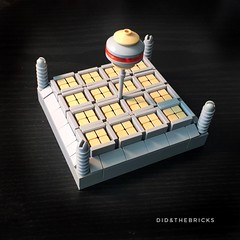

I have been revisiting my sundial designs in the hope of commercializing them to some extent. The equatorial dial pictured above has been put up as a project at LEGO CUUSOO just in case there are at least 10,000 other LEGO/Sundial enthusiasts out there who would like to see this model in production by LEGO some day. If you happen to be one, please consider supporting this project – and any of the other excellent projects posted at the site. It seems the majority of the popular projects at LEGO CUUSOOO have to do with popular movies or video games. It would be nice if more original models got the same kind of spotlight.
The LEGO Company recently announced the upcoming release of a “Lord of the Rings” series of sets and figures to be marketed directly to hobbits. With this release LEGO has moved a step farther from its history of providing species-neutral toys that promote playing safely at home on the floor.
Exactly what messages are these LEGO sets sending to our hobbit children? That they should leave their cozy earthen homes and endanger their own lives and the lives of their friends? That hobbits are courageous adventurers who literally hold the fate of Middle Earth in their hands?
Our hobbit children have been absorbing these stereotypes for thousands of years now and it has affected their impressionable minds. Studies have shown that left on their own hobbits as young as 35 and 40 years old will start playing at killing orcs, slaying dragons and climbing trees. Should a responsible toy company be encouraging our hobbit children to climb five or six feet into a tree instead of staying well underground where it is safe?
And why are the sets marketed to hobbits mostly in bricks of muted browns and grays? Contrary to the stereotype, hobbits enjoy a dash of bright color now and then. By making these sets in such drab colors, LEGO is sending a clear message: Hobbits Only. Most stores will be stocking these sets in the Halfling aisle of their toy sections where human, elf and dwarf children are discouraged from shopping.
Why does LEGO see the need to market a line of sets aimed directly at hobbits, anyway? What happened to the old philosophy of a species-neutral LEGO universe? LEGO should stop telling our hobbit children to run off on foolish and dangerous adventures and associate with dwarves. LEGO should stick to its respected tradition of encouraging our hobbit children to become pirates, ninjas or hairdressers.
It was on January 28, 1958 that Godtfred Kirk Christiansen filed the Danish patent application for a “legetøjsbyggeelement” that used a knob and tube configuration for connecting plastic building bricks. The patent, number 92683, was granted exactly 4 years later in 1962.
I have been playing with LEGO bricks for about 40 years. The LEGO sets of my youth were the general building sets familiar to many adult fans. These were the re-suable box sets made up of basic bricks in basic colors. There were no specific instructions, but the boxes were illustrated with some complete models and there would sometimes be a (quickly-lost) booklet with more ideas.
The idea was to make your own creation. There were few specialized pieces, and even these were pretty basic elements like slopes, wheels, and curved pieces. The figures had no moving arms and no faces.
When the Technic line was introduced in the late 1970s, I was the perfect age. Here were “Expert Builder” sets that anticipated the development of those LEGO kids who had imagined how great it would be if the little LEGO car they had pushed along the rug had actual gears and a motor and could move by itself. The Expert Builder sets were of specific models and had complete building instructions, but of course the pieces were all standard and could be combined with other sets to build ever more complicated machines.
Raised as I was on the “old school” LEGO sets, I was one of those snobs who cried that LEGO had sold out and turned its back on all of us by introducing themed sets in the late 70s and 80s. Part of it was that I was then entering my teens and was not terribly interested in the knights, pirates and astronauts that peopled the new LEGO universe. The models on the boxes were impressive, but didn’t they discourage imagination and creativity?
Of course they didn’t. Building the model on the box was the first thing you did. Then you played with it for a while and maybe put it on your dresser to admire for a few days. Then you went back to your big box of mixed bricks and started making something new, borrowing pieces from the model as needed until you completely took it apart and it was absorbed into your collection.
But now this criticism of LEGO has risen again, but from a different source: young women. A group called SPARK that seeks to address issues of sexualization and stereotyping of girls and women has likened the new LEGO Friends line of sets to products like Bratz, claiming they stifle the imagination and creativity usually associated with LEGO products and replace them with “messages about the value of shopping, clubbing, baking,and tanning.”
I have read the open letter that SPARK sent to LEGO several times, trying to understand what is at the root of their complaint. This isn’t as straightforward as it seems, because they make some claims and insinuations in their letter that are not supported by facts. There are no tanning beds in any of the new sets, for example, so how it is LEGO is sending a message about the value of tanning is not clear. There are no sets that have “shopping” as part of the theme, either. I think the reference to “clubbing” may be from the Andrea character. Andrea is a musician. She comes with pieces to build a stage and a grand piano. She does not come with a red rope, cocktail glasses or a VIP room.
As for “baking,” there is indeed a set centered around this theme. It’s a bakery, and the storyline indicates the bakery is owned and operated by the character in the set. She doesn’t stay home and bake cookies for the family, she owns a small business.
SPARK seems to be ignoring the actual storylines that LEGO suggests and making up their own sexist versions. I’m not real clear on what is sexist about a set that has a character lounging beside a pool, but SPARK appears to have a real problem with it.
After some thought, I think the root of their problem with the pool set – and with the Friends line in general – is that it looks too much on the surface like other dolls marketed at girls. There are some crucial differences, however.
First, SPARK focuses on only two or three of the sets in their criticism, and they mischaracterize these in order to make their point. Other sets include a veterinarian’s office, a design studio and an engineering workshop. Where among the Barbie and Bratz products are the ones acknowledging girls interested in science and math?
Second, there are no boys. One of the sets has a father character, but unlike the Barbie and Bratz lines there are no dreamy-eyed mop-top boys hanging around creating inappropriate sexual tension.
Third, these are LEGO sets. The buildings and vehicles are built completely from the same individual bricks found in other sets. Kids can build the model on the box, or use the pieces to make anything else they imagine, as they have been doing with other themed LEGO sets for the past 30-plus years. This kind of creativity is not only encouraged by LEGO, but there is an enormous community of LEGO fans that appreciate and support this kind of creativity.
It is the job of parents to raise their children, not toy companies. SPARK complains that LEGO is not giving girls enough credit, but it may be that SPARK isn’t giving girls enough credit either. It is true that kids are very aware of the implicit messages delivered through toy marketing. They need a parent who can help put these messages in context and understand their purpose.
As I was about to publish this post, I came across this excellent (and detailed) post on the subject by David Pickett which makes some similar points and provides a lot of good background.
I ordered a couple small buckets of bricks from shop.lego.com earlier this week and was surprised when the postal carrier had to make a special trip to his car to get the package. At 27″ wide, it was difficult to carry through the front door lengthwise.
This box was perhaps not the perfect size for my order:
For reference, those buckets are about 11 inches long. They could have fit 6 or 7 of them in this box.
Everything was in good shape – LEGO bricks are light and durable, of course – but I have another slight problem with LEGO’s shipping. They use the “Smartpost” method, where they use FedEx to ship the package to the local USPS post office, which then delivers the package to the final destination. (UPS has a similar service available)
The first annoying thing about Smartpost is that it usually adds at least one day to the shipping time because the local post office has to sort it.
The second annoying thing is that the tracking systems for FedEx and USPS are not integrated and when your package gets handed off from one service to the next, it goes into a kind of twilight zone where you have no idea when it will actually arrive. For almost two full days my package showed “in transit” between two large US cities that are just hours apart. It didn’t really take two days – that’s just how long it took from the time FedEx delivered it to USPS until USPS scanned it.
In the meantime, tracking the package on FedEx gave a delivery date of Monday 1/23. Tracking it with USPS gave no information at all until the package was already at my local PO and out for delivery – on Saturday, 1/21.
So a happy ending, I guess. I got my order sooner than FedEx said I would, and I now have a sturdy packing box that can hold the entire contents of a standard bedroom closet.
Medium Blue is ten years old. The first LEGO sets including the color were released in 2002 according to information at Peeron.com and since that time some 3,500 elements have been released in this soft, pleasing color, making it currently the 25th most common color for LEGO elements.
Although sometimes categorized as a “girl” color because of its muted tone and inclusion in several Belleville sets, one of the first sets to use medium blue was 4728 Escape from Privet Drive from the Harry Potter series. In that set it was used for the Weasley car, pictured above.
The color has been embraced by LEGO fans, as is evident from a quick Flickr search:
Though not exactly scarce, medium blue elements are not included in large numbers in many sets. They are frequently used to add accent color, as with the recent Imperial Flagship
Some of the current sets that include medium blue elements include Kingdoms Joust and several of the new Friends sets.